
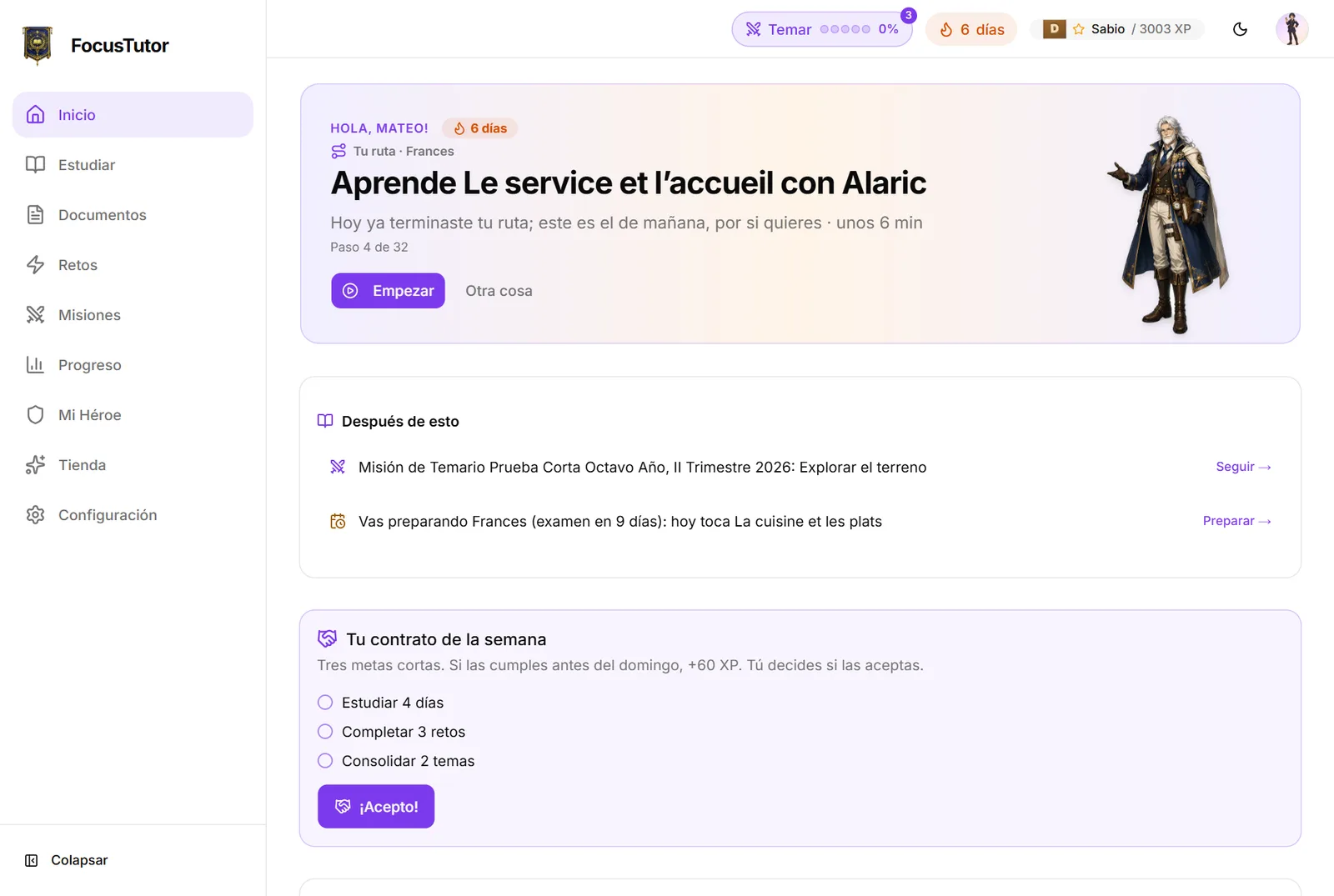
Once they sit down, they stay
One big button and another for “just 2 minutes”. Seven-minute blocks with breaks, and an “I got distracted” that resumes without asking what happened.
See it in the guideFor families of children and teens with ADHD or autism, or who simply get distracted easily
FocusTutor AI turns their school notes and syllabus into short rounds and missions they can hold their attention on. It never hands them the answer: it gives hints and tricks to remember. And it tells you whether they really studied, where they got stuck and what to try at home.
Built for the student who struggles to start, keep going and know where to go next, and for the adult who supports them without wanting to police them.

What makes FocusTutor different
Any AI tutor explains. FocusTutor is built for the student who does not start, and for the adult who needs to know without a fight.
One big button and another for “just 2 minutes”. Seven-minute blocks with breaks, and an “I got distracted” that resumes without asking what happened.
See it in the guide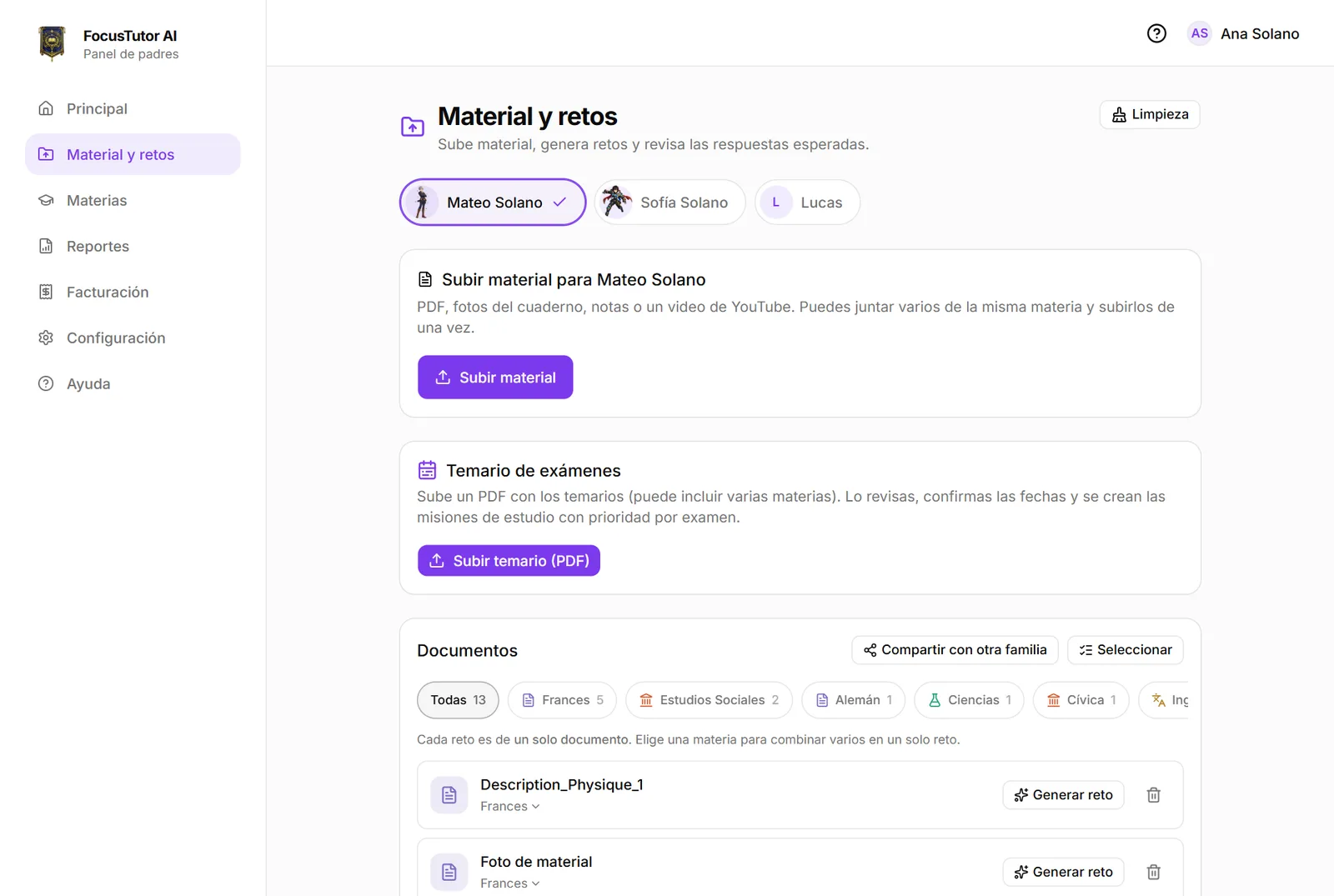
Upload the PDF, the notebook photos or the exam syllabus. The mentor explains and asks about that, and the exam becomes dated steps.
See it in the guide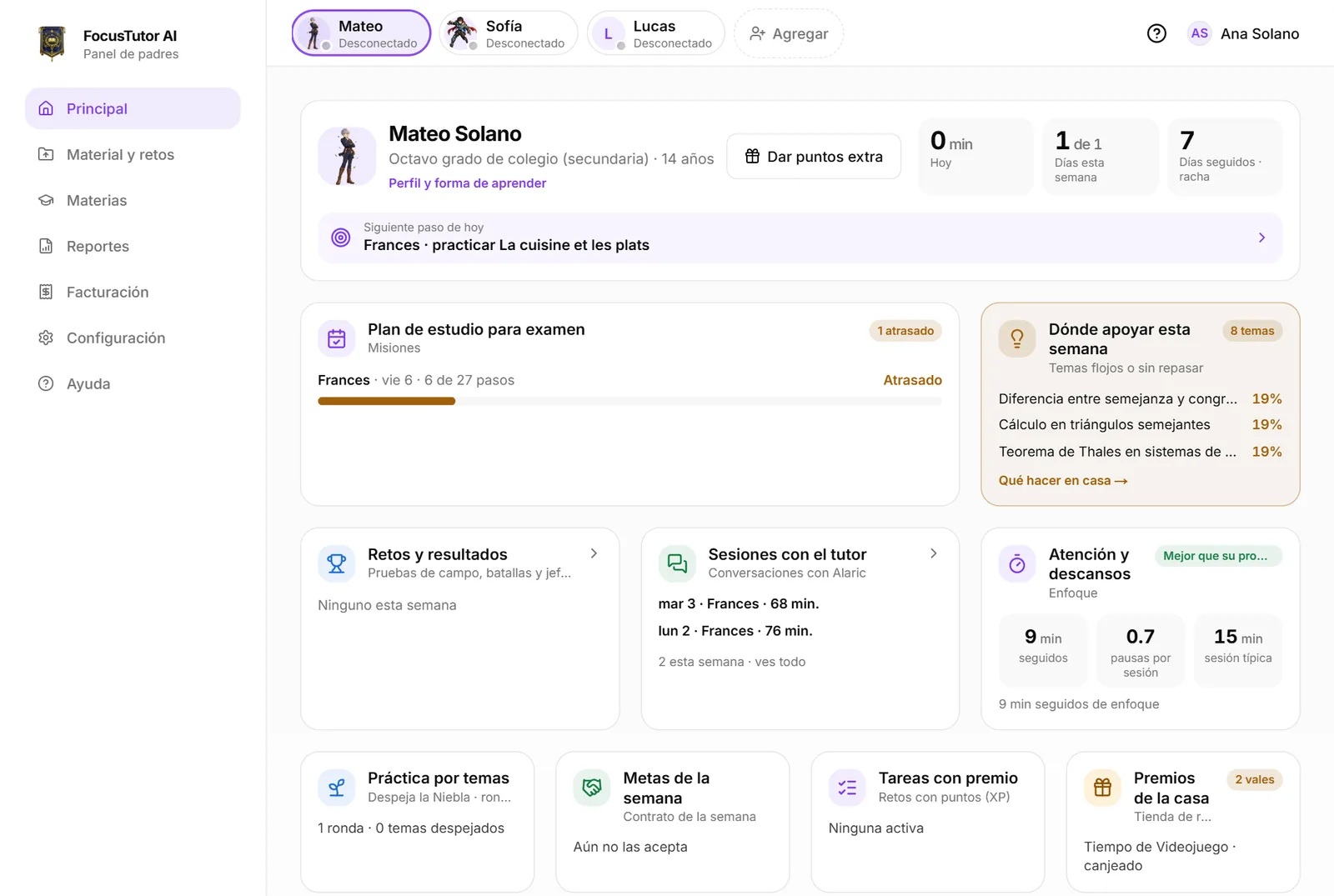
Whether they studied today, how many days this week, where to help and what to say. An e-mail when something worth knowing happens. The full conversations stay in your panel, and your child knows you can read them.
See it in the guide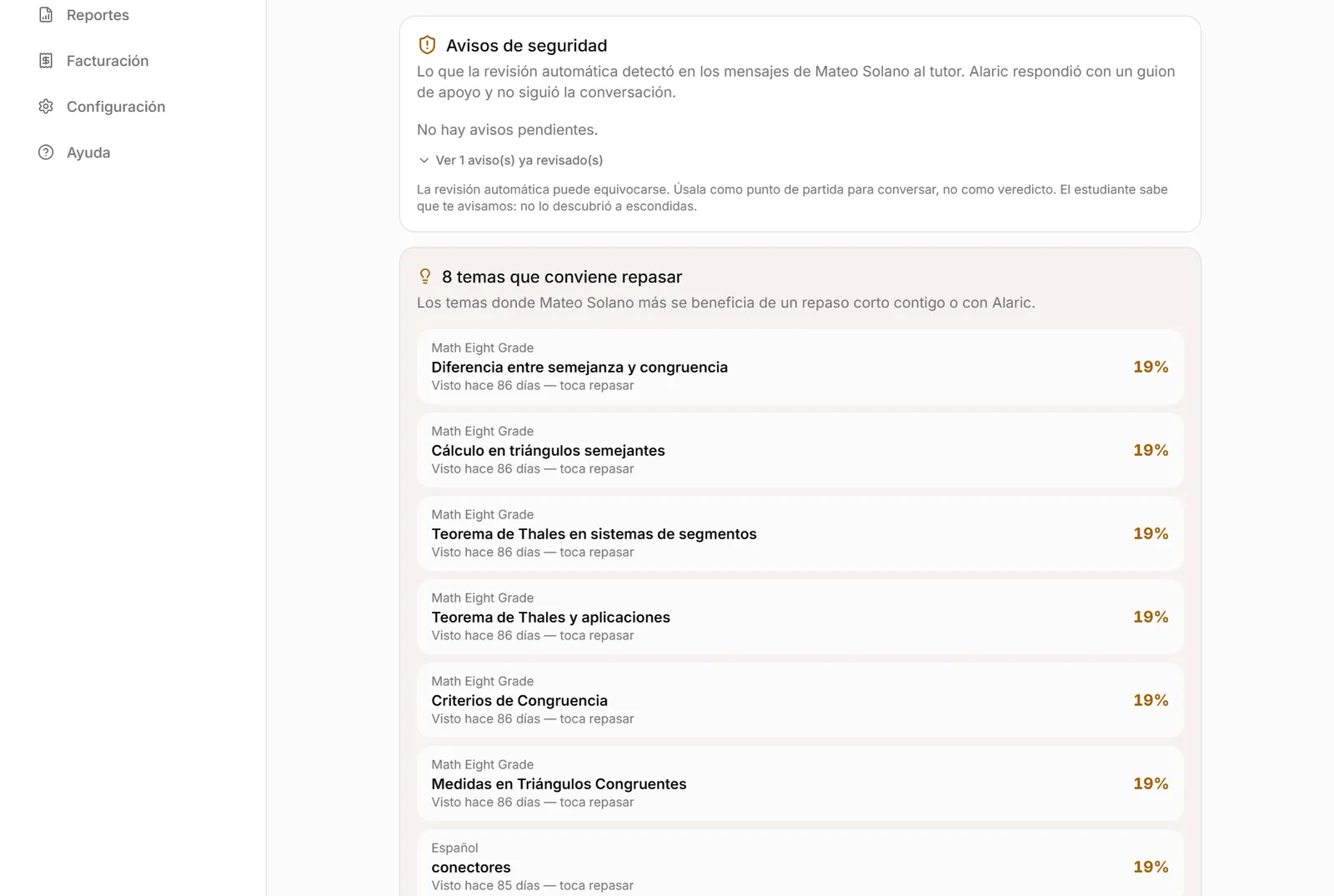
An automatic filter looks for signs of self-harm, sexual content or threats in every message to the tutor. If it detects something, the mentor answers with support, you get an e-mail with an excerpt, and the student knows. The filter can fail or be wrong: it is a safety net, not a guarantee.
See it in the guideHow it works
A clear path that turns schoolwork into small, visible, achievable steps.

A short questionnaire turns their interests and preferences into a unique character and a study experience designed for them.

Upload PDFs, photos, or notes. FocusTutor uses those materials to create explanations, guided sessions, and challenges adjusted to their level.

Every completed session and challenge earns experience for their character. As they demonstrate mastery, more advanced tests and better rewards appear.
While they progress through the adventure, you can review study time, subjects practiced, and results.
What is included
A tutor that never does the homework, their own material, short sessions, challenges, a route to the exam and a panel that tells you where to help. Every feature, explained by the problem it solves.
Motivation they can see
For many students, knowing that an exam is several weeks away is not enough to stay motivated today.
Assignments can feel too large, repetitive, or unstimulating. Getting started is hard. Keeping momentum can be even harder.
FocusTutor divides learning into manageable goals and provides visible feedback and progress during the process, not only after a grade arrives.
The student gets a reason to complete the next step.
The parent gets a clearer way to understand progress.

Alaric, the mentor
“We are not going to study more hours. We are going to study better, together. We start with two minutes.”

Nox, the rival
“I feed on what you leave for tomorrow. Every challenge you do takes health from me.”
For the student, the app is an adventure with a mentor and a rival. For you, it is a clear panel.
Built with ADHD and autism in mind
I built it with my three children as the first users and critics: one with ADHD, one autistic, and the eldest with both. That is why there are pieces for each profile.
If they have ADHD
The hard part is starting and sustaining. Hence the two-minute button, seven-minute blocks with breaks, a near reward in every challenge, and a mentor who picks up without scolding when they drift.
If they are autistic
The hard part is the unpredictable. Hence always the same mentor with the same tone, fixed blocks, a schedule that is respected, an exam turned into dated steps, and literal explanations, with no surprises and no overload.
FocusTutor does not diagnose or label: the tutor never mentions the condition to the student. It only adapts.

Trust and privacy
Families should know what information exists, who can see it, and how it is used. These are the product decisions in place today.
Study time, subjects practiced, results, progress, and weekly summaries. The goal is to support with context, not monitor every move.
The parent dashboard shows the full conversations with the tutor, not just summaries. No secrets in either direction: students know their family can read them.
PDFs, images, and notes are kept in private storage while the account is active. Materials can be deleted from the app.
We use Supabase, Vercel, OpenAI, Resend, and Sentry to run the service. We do not sell data or use materials to train our own models.
Study history can be deleted in Settings. Full account deletion can be requested at dani@photonshapers.com.
Students can adjust text size, motion, sounds, and explanation format. Pace and difficulty also respond to performance.
Who is behind it
I'm Daniel Rojas, from Costa Rica, and I have three neurodivergent children: one with ADHD, one with autism, and the eldest with both. I couldn't find any tool they could hold their attention on, that pushed them to try instead of handing them the answers, and that told me whether they had really studied and where they needed help, so I built one. The three of them are my main users and my toughest critics. It helps me keep them motivated and measure their progress (I'm autistic too, and I like seeing numbers). It doesn't remove the need to be there: I still check in, and every so often I sit down with them to see how they're doing and what they're stuck on. But it is far better than leaving them with a chatbot that has no context.
FocusTutor is configured to discover what the student already knows, explain one idea at a time, and check understanding. When asked for an answer, the tutor moves through hints so the final step still belongs to the student.
Helps identify the next reasoning step without handing over the solution.
Brings the concept closer with an analogy or part of the process.
Prepares almost everything, but the student completes the answer.
How to start today
Any family can start with the Free plan. When you need more, paid plans expand the sessions, the materials and the report you receive.
To try it: 8 sessions a month.
No card, no commitment. Enough to see a real session with your child and the panel that shows you what happened.
$0/month
For families with children who get distracted, or with ADHD or autism, who want to try the full version for a month and tell us the truth.
What you get
What we ask
Ask for a spot
Five questions, two minutes. We read every request by hand and reply by email.
One child, weekday studying.
Regular support for one student.
$8/month
USD, plus taxes for your country
Up to 2 children or exam weeks: twice the sessions.
More support for intensive weeks and varied materials.
$15/month
USD, plus taxes for your country
Up to 4 children, with a family overview.
A shared allowance for the whole family.
$29/month
USD, plus taxes for your country
Prices are in US dollars. Taxes for your country are calculated and added at checkout. Payment is processed by PayPro Global as the authorized reseller, and you can cancel anytime from your account.
A support resource is one document analysis or one generated visual. Students never see prices or purchases inside their experience.
Frequently asked questions
Yes. Free remains publicly available with a limited monthly allowance and requires no credit card. If you need more, paid plans are billed monthly in US dollars, plus taxes for your country.
It counts when a student starts a guided study session. Each session includes at least 50 messages with Alaric and nearly always goes further. If a session gets very long, Alaric offers to continue in a new session with the same material and a summary of where you were; that one counts as another session. Breaks don’t count.
It is the analysis of a PDF, photos, notes, or a video you upload as study material. Visuals (diagrams, illustrations, challenge scenes and the hero portrait) have their own quota.
Unlimited spending is never enabled. New actions of that type wait for the renewal on the 1st of each month or for the responsible adult to change plans. Without visuals left, challenges continue with educational stock images or no image; without voice minutes left, the device voice reads aloud.
A small group of invited families that uses the full version at no cost for a month and tells us honestly what works. It creates no subscription or automatic charge: we turn it on and off by hand. You ask for a spot with the form on this page and we reply by email.
Yes. It is built for the autism spectrum too: always the same mentor with the same tone, fixed blocks, literal explanations and a schedule that is respected. The tutor never mentions a diagnosis to the student, it only adapts. It also works for kids who have both ADHD and autism, and for those who simply get distracted easily.
Create a parent account, prepare your child's profile, and turn their next school material into a guided session.